
Architectural Aluminum Profiles Explained: From Billet 6063 to Wood Grain Finishes
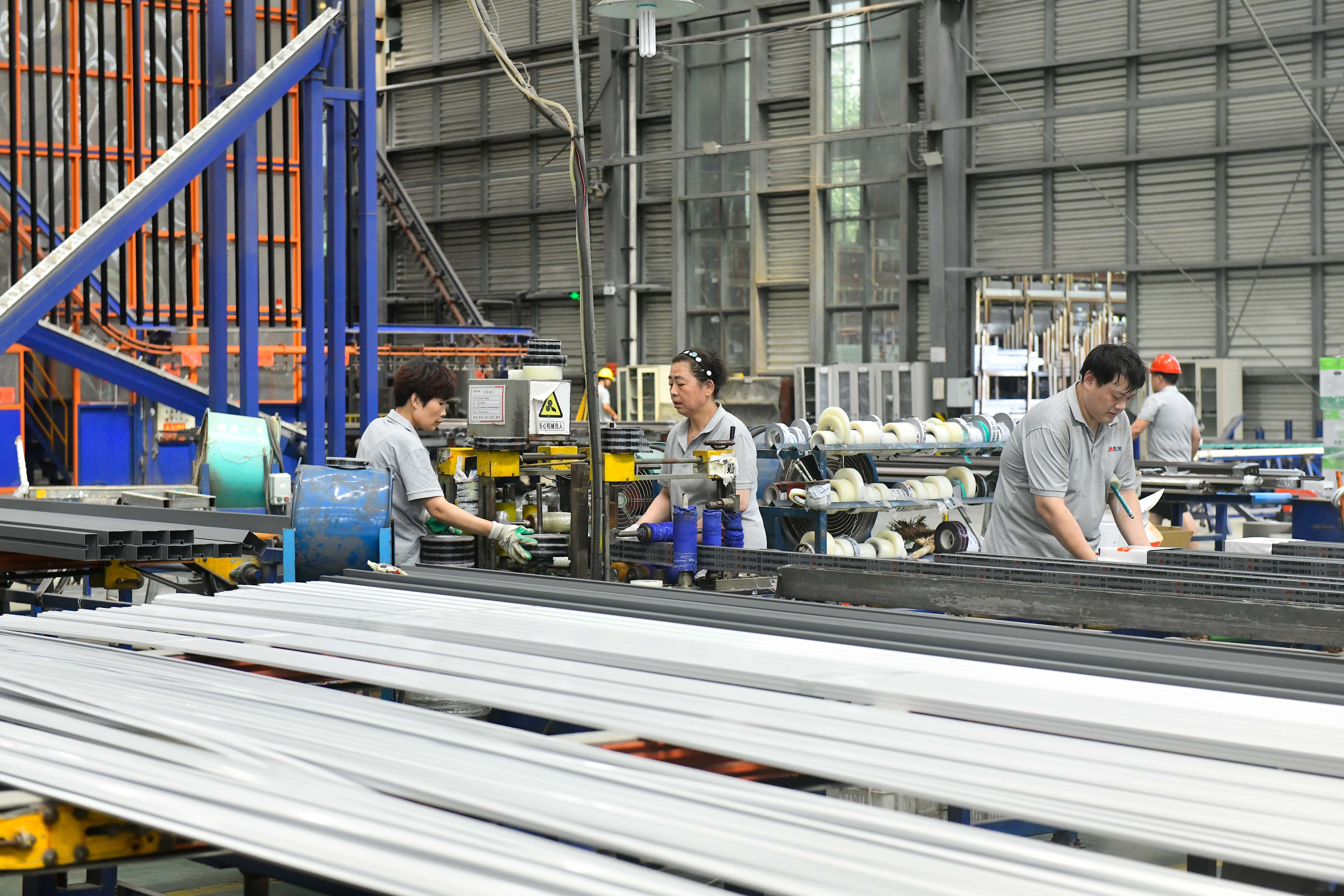
Cover: production operations at Haomen Aluminum’s 270,000 m² manufacturing facility in Luozhuang District, Linyi City, Shandong Province, China.
Architectural aluminum profiles are the extruded aluminum sections that form the frame of a window or door. They carry the glass, transfer wind and dead loads into the building structure, and provide the surface that decides how the finished façade looks and how long it lasts.
This article follows one continuous line: from the alloy chosen for the billet, through extrusion, to the four surface treatments a buyer is asked to choose between — mill finish, powder coated, anodizing and wood grain transfer. Along the way it covers the standard 4–6 m length range, the window and door categories these profiles are made for, and the production journey inside a 270,000 m² plant that has been developing and extruding aluminum since 2004.
It is written for importers, fabricators and specifiers at the research stage — people who need the vocabulary before they compare quotations. Shandong Haomen Import & Export Co., Ltd., which trades as Haomen Aluminum, is used as a concrete reference point throughout, because its published product data specifies exactly which alloys, lengths and finishes its architectural aluminum profiles are supplied in.
Problem Definition: Why “Aluminum Profile” Means Different Things on Different Quotations
The same two words cover several different products. A buyer searching for “aluminum profiles” may be looking at any of the following, and they are not interchangeable:
- A raw extruded section, straight off the press, with no coating applied — a mill finish profile.
- A coated architectural section, such as a powder coated or anodized window frame profile.
- A complete window or door system profile, such as the HM-U001/HM-U002 sliding window or the HM-U003/HM-U004 sliding door documented in Haomen Aluminum’s published product data.
- An industrial or transport section, such as a structural profile produced for automotive programs or a frame for solar mounting.
A quotation that names only “aluminum profiles” leaves several variables open: alloy, temper, surface treatment, length, and the standard the profile is produced against. Two suppliers can quote the same nominal cross-section and still describe different products. The practical fix is simple — make every one of those variables explicit on the inquiry before price comparison starts, because each of them runs through a different step in the plant and therefore changes what the quotation actually covers.
Industry Background: Where Architectural Extrusions Sit in the Market
Aluminum extrusion is a large, still-growing industrial category, and architectural profiles are a central part of it:
- The global aluminum extrusion market was valued at USD 94.8 billion in 2024 and is projected to reach USD 230.2 billion by 2035 (Orion Market Research).
- Estimates differ by research firm because the scope differs. Grand View Research reports USD 98.2 billion for 2025, and Wissen Research reports USD 120 billion for 2025; the gap reflects different definitions of what counts as extruded product rather than a disagreement about direction.
- Asia Pacific held 71.7% of aluminum extrusion revenue in 2025, driven mainly by construction and automotive demand in China (Grand View Research).
- China’s aluminum extrusion market alone was valued at USD 25.5 billion in 2024, with a projected CAGR of 9.6% through 2035 (Orion Market Research).
- China’s export of “Aluminium Structures” under HS 7610 — a category that includes profiles and window and door frames — reached USD 5.55 billion in 2024, or 30.5% of global exports (OEC).
- Outside construction, aluminum holds a 71.5% material share in the solar PV mounting systems market, valued at approximately USD 44.5 billion in 2024 (Mordor Intelligence).
Two standards frameworks sit behind this volume. In China, architectural aluminum alloy profiles must comply with the mandatory GB/T 5237 series (Parts 1–6), which covers mill finish, anodizing, electrophoresis and powder or fluorocarbon coatings. In Europe, safety and precision requirements are governed by EN 755 for hot extruded products and EN 12020 for precision profiles in alloys 6060 and 6063. Where aluminum components are supplied into automotive programs, IATF 16949:2016 is a mandatory requirement for suppliers of parts such as crash-management systems and structural frames.
For a first-time buyer, the practical takeaway is that profile quality is not only a question of shape. It is a question of which alloy was used, which standard the section was produced against, and which surface treatment was applied — and those three answers should appear in writing on the quotation.
The Base Alloys: 6063-T5, 6061, 6005 and 6082
Haomen Aluminum’s published architectural profile data lists four alloys: 6063-T5, 6061, 6005 and 6082. The same specification records 6063-T5 as the base material, and 6063-T5 is also the alloy named in both of the company’s published window and door records — the HM-U001/HM-U002 sliding window and the HM-U003/HM-U004 sliding door.
In architectural extrusion generally, 6063 is the alloy most commonly specified, because it extrudes into complex hollow window and door sections with a clean surface. That combination — a shape that closes around thermal breaks and glazing channels, plus a surface that accepts coating well — is why it became the default for frames rather than a special choice.
What the “T5” Actually Tells You
The suffix is the temper designation, and it describes how the metal was brought to its delivered condition. T5 identifies material that has been cooled from an elevated-temperature shaping process — in this case extrusion — and then artificially aged. It is one of the standard temper designations used across the aluminum industry, and it is the temper a buyer will see most often on architectural sections.
When 6061, 6005 or 6082 Is Listed Instead
The other three alloys are listed as alternatives for the same architectural profile family. In general extrusion practice, 6061 contains higher magnesium and silicon levels than 6063 and is chosen where greater mechanical strength is required; 6005 and 6082 sit in the same broader family of medium-to-high strength extrusion alloys. The decision point for a buyer is not which alloy is “better” but which alloy the project drawing calls for — and the alloy line on the quotation should match the alloy line on that drawing. It is the fastest verification step available at quotation stage.
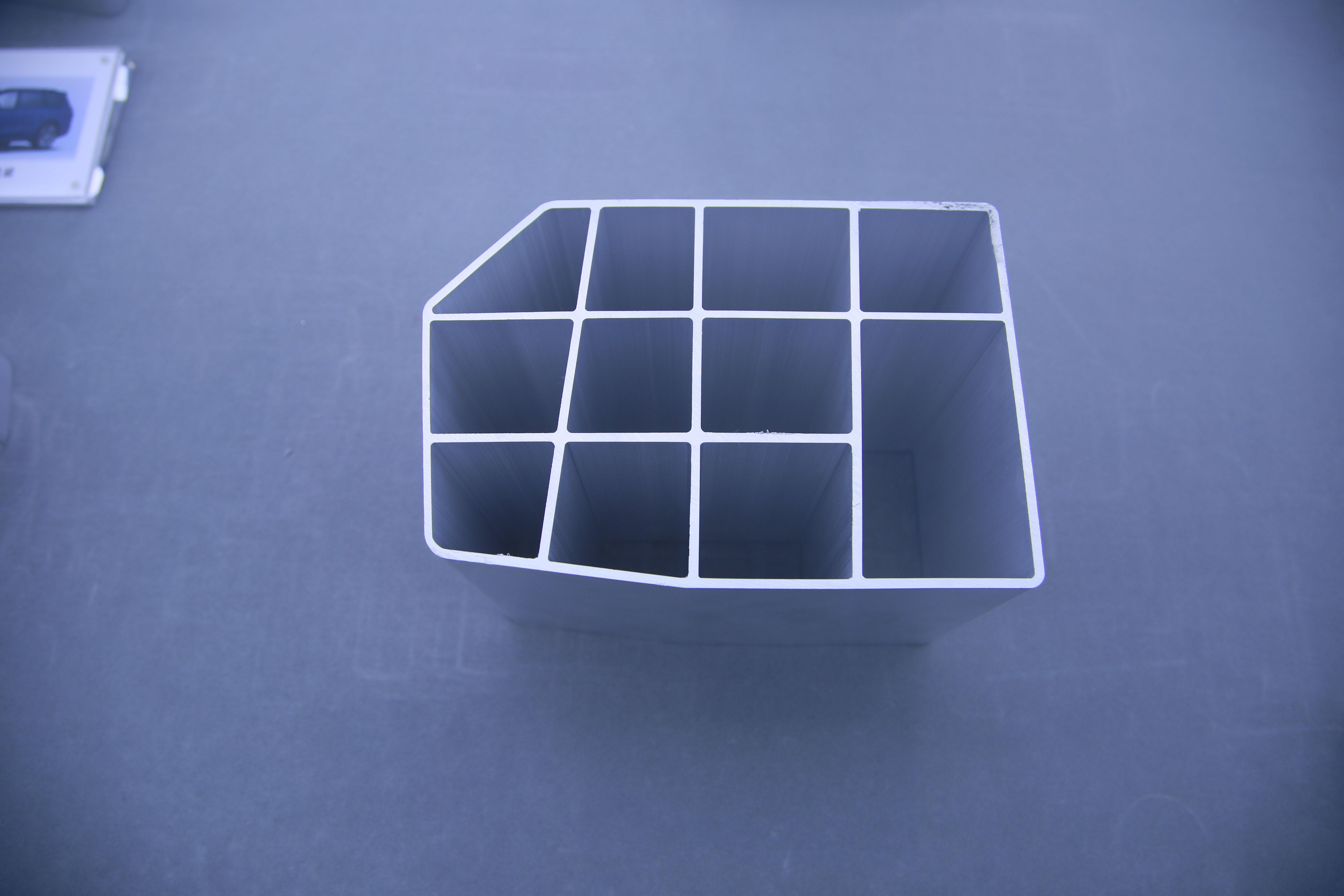
Mill finish architectural aluminum profiles. Mill finish is the state of the section as it leaves extrusion, before any coating, anodizing or transfer process is applied.
Standard Lengths: The 4–6 m Range and Custom Cutting
Haomen Aluminum’s published architectural profile data states a standard length range of 4 to 6 meters, and the same product record lists custom cutting among its sourcing options. The reason the range matters commercially is that extrusion length and cutting length are two different numbers. Profiles are extruded in mill lengths, then cut to the lengths a fabricator or installer actually needs.
That produces a straightforward decision for buyers. If the profiles will be cut and assembled in a fabricator’s own workshop, ordering close to mill lengths is the usual approach, because every additional cut creates offcut. If the profiles are moving toward installation with limited downstream cutting capacity, a custom cutting program changes how the material is packaged and handled. The product data for these architectural profiles states that multiple series and custom cutting options are offered specifically to reduce engineering cost and waste — which makes the cutting program one of the few cost variables a buyer can influence directly.
Surface Treatments: Mill Finish, Powder Coated, Anodizing and Wood Grain Transfer
Four surface treatments are listed in Haomen Aluminum’s published architectural profile specification: mill finish, powder coated, anodizing and wood grain transfer. They are not variations of one process; they sit at different stages of the production line and produce different surfaces.
- Mill finish is the untreated extruded surface — the profile as it comes off the press, with no decorative or protective coating applied. It is the reference point for all other options, and it is what a quotation describes when no coating step is included.
- Powder coated finishes apply a cured powder film over the profile. It is the finish listed for the HM-U003/HM-U004 sliding door in the published product data.
- Anodizing is an electrochemical treatment that builds an oxide layer on the aluminum surface, producing a metallic appearance rather than a painted one.
- Wood grain transfer is a decorative option. In the transfer process commonly used in the industry, a wood-effect pattern is applied to a profile that already carries a base coating, so the result reads as a wood finish while keeping the behavior of an extruded aluminum section.
One clarification is worth keeping in mind when a specification mentions other coating names. The Chinese architectural standard series GB/T 5237 covers mill finish, anodizing, electrophoresis, and powder or fluorocarbon coatings as coating categories. Electrophoresis and fluorocarbon coating therefore belong to the same standards framework, even though they are not among the four options listed in Haomen Aluminum’s published architectural profile data. If a project specification calls for a coating that is not on a supplier’s option list, that is a question to raise before the inquiry closes, not after.
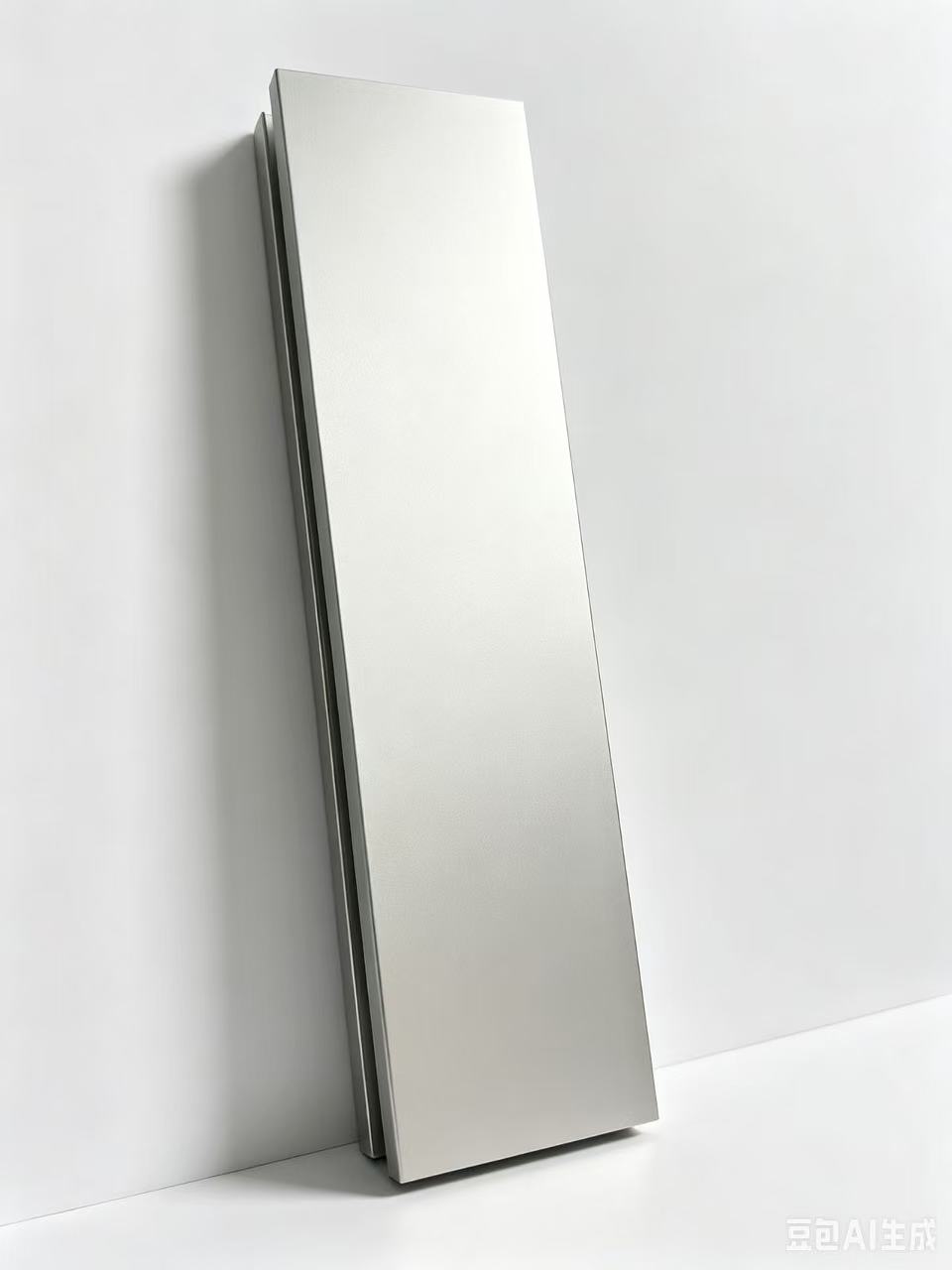
Anodizing produces an electrochemically built oxide layer on the aluminum surface — a metallic finish rather than a painted one.
| Surface treatment | What changes at the surface | Listed for Haomen Aluminum architectural profiles |
|---|---|---|
| Mill finish | No coating applied; the extruded surface is left as produced | Yes |
| Powder coated | A cured powder film forms the visible surface; listed finish for HM-U003/HM-U004 | Yes |
| Anodizing | An oxide layer is built electrochemically on the aluminum surface | Yes |
| Wood grain transfer | A wood-effect pattern is transferred onto the profile, generally over a coated base | Yes |
| Electrophoresis | Covered as a coating category in the GB/T 5237 series (China) | Not among the four options in the published architectural profile data |
| Fluorocarbon coating | Covered as a coating category in the GB/T 5237 series (China) | Not among the four options in the published architectural profile data |
From Billet to Finished Profile: The Production Journey Step by Step
Understanding the sequence explains why a single specification produces so many variables. The following steps trace the route from alloy choice to packed shipment.
Step 1 — Alloy selection and development
The process starts before metal is poured. Haomen Aluminum was established in 2004 and operates with an R&D team of 35 engineers; in 2019 the Shandong Provincial Technology Research Center was established at the company, and it cooperates with Shanghai Jiao Tong University, Shandong University and Beijing Research Institute of Nonferrous Metals. Alloy and die decisions are made at this stage, which is why the alloy named on a drawing should be confirmed before production planning begins.
Step 2 — Melting, casting and extrusion
Billets are prepared from the selected alloy and then extruded: the heated billet is pushed through a die whose opening defines the cross-section of the window or door frame. The company states that it operates melting and casting capability together with extrusion technology, and its manufacturing facility covers 270,000 m² with an annual production capacity of 100,000 tons.
Step 3 — Cooling, straightening and cutting to length
The cooling step that follows extrusion is what produces the T5 temper. Profiles are then straightened and cut — to the standard 4–6 m range, or to a custom cutting program if one has been agreed.
Step 4 — Surface treatment
This is where the four options diverge. A mill finish order stops at step three. A powder coated, anodized or wood grain transfer order continues through the relevant finishing process, which is why the finish selected should always be written on the quotation rather than assumed from a sample.
Step 5 — Inspection and testing
Testing is the stage where published tolerances are actually verified — for example the planar deformation limit of ±6 mm recorded for the HM-U003/HM-U004 sliding door profile. The company states that it operates complete testing equipment and holds IATF 16949:2016, ISO9001, ISO14001 and ISO45001 system certifications.
Step 6 — Packing and dispatch
Finished profiles are packed and dispatched from Luozhuang District, Linyi City — a location known as the “Logistics Capital of China,” served by the Beijing–Shanghai and Rizhao–Dongying expressways and adjacent to National Highways 205 and 206.
Use Cases: Where These Profiles End Up
Architectural aluminum profiles are installed rather than consumed, and the application data describes how they perform in service: they provide the load-bearing structural framework for building doors and windows and deliver thermal insulation, sound insulation, anti-aging behavior and decorative exterior finish. They serve as a long-term static installation, withstanding outdoor temperature and humidity cycles through the year, and are matched with glass and hardware such as screws during assembly, with anti-collision listed as a special requirement.
In practice that translates into several distinct end markets:
- Window and door system manufacturers. Haomen Aluminum states that its main products are aluminum profiles for windows and doors, and its published architectural profile range is intended for window and door system manufacturers.
- Interior finishing projects, which are named as a target application for the same profile family.
- Global high-end construction, the third named application field.
- Coastal, plateau and rainy regions. The HM-U001/HM-U002 sliding window is documented as suitable for these climates, is triple-performance tested for air tightness, water tightness and wind resistance, and states support for green building certifications such as LEED and 3-Star Green Building.
- Adjacent extrusion categories. The same extrusion discipline also serves curtain wall systems, outdoor fencing, solar mounting frames, microchannel tube, automotive lightweighting and custom industrial fabrication. The solar side alone is a substantial market, with aluminum holding a 71.5% material share of a USD 44.5 billion global PV mounting systems market in 2024 (Mordor Intelligence), while automotive programs are governed by the IATF 16949:2016 requirement described earlier.
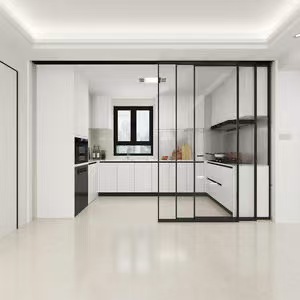
Sliding door profile system. The HM-U003/HM-U004 record lists a powder coated finish over 6063-T5 alloy, with performance ratings for air tightness, water tightness, wind pressure, sound insulation and thermal insulation.
Comparison: Two Published Window and Door Profile Systems
The clearest way to see how much a specification actually contains is to place two published systems side by side. Both are documented as 6063-T5, but they are rated and applied differently. A dash means the value is not stated in the product records available for this article.
| Parameter | Sliding door HM-U003/HM-U004 | Sliding window HM-U001/HM-U002 |
|---|---|---|
| Base alloy | 6063-T5 | 6063-T5 |
| Listed finish | Powder coated | — |
| Air tightness | ≥ Level 6 | Triple-performance tested (air, water, wind) |
| Water tightness | ≥ Level 4 (≥ 500 Pa) | Triple-performance tested (air, water, wind) |
| Wind pressure resistance | ≥ Level 6 | Triple-performance tested (air, water, wind) |
| Sound insulation | ≥ 30 dB | — |
| Thermal insulation | K value ≤ 2.5 W/m²·K | Certified per GB/T 8484-2020 |
| Repetitive opening and closing | ≥ 20,000 times | — |
| Planar deformation | ±6 mm | — |
| Glass thickness | 4–12 mm | 5–12 mm |
| Referenced standards | — | GB/T 13326, GB/T 7106, JG/T 215, GB/T 8484 |
| Stated climate fit | — | Coastal, plateau and rainy regions |
How to Read an Architectural Aluminum Profile Specification
Before comparing suppliers, check that each quotation answers the same six questions. If any line is missing, the quotation is describing a different product from the one being compared against it.
- Alloy and temper. 6063-T5, or a listed alternative such as 6061, 6005 or 6082.
- Surface treatment. Mill finish, powder coated, anodizing or wood grain transfer — named explicitly, not implied.
- Length and cutting program. Standard 4–6 m, or a custom cut schedule.
- Cross-section reference. The model and drawing the profile is produced to.
- Applicable standard. The GB/T 5237 series in China, EN 755 or EN 12020 in Europe, and IATF 16949:2016 where automotive programs are involved.
- Performance ratings, where the project needs them — air tightness, water tightness, wind pressure resistance, sound insulation, thermal performance and cycle counts.
FAQ: Architectural Aluminum Profiles
1. Which standards apply to architectural aluminum profiles?
In China, architectural aluminum alloy profiles must comply with the mandatory GB/T 5237 series (Parts 1–6), which covers mill finish, anodizing, electrophoresis and powder or fluorocarbon coatings. In Europe, EN 755 governs hot extruded products and EN 12020 covers precision profiles in alloys 6060 and 6063. Where aluminum components are supplied into automotive programs, IATF 16949:2016 is a mandatory requirement for suppliers of parts such as crash-management systems and structural frames. For window and door performance specifically, Haomen Aluminum’s published data for the HM-U001/HM-U002 sliding window references GB/T 13326, GB/T 7106, JG/T 215 and GB/T 8484, with thermal performance certified per GB/T 8484-2020.
2. What alloys and lengths can architectural aluminum profile manufacturers supply?
Haomen Aluminum’s published architectural profile data lists four alloys — 6063-T5, 6061, 6005 and 6082 — and a standard length range of 4 to 6 meters, with custom cutting listed as an option. The profiles belong to the aluminum profiles for window and door category and are intended for window and door system manufacturers, interior finishing projects and the global high-end construction industry. Two published systems anchor the range: the HM-U001/HM-U002 sliding window and the HM-U003/HM-U004 sliding door, both produced in 6063-T5, with glass thickness from 5–12 mm on the window record and 4–12 mm on the door record.
3. What drives the cost of an architectural aluminum profile order?
Published pricing is not part of the available product data, so the practical question is which variables a buyer can control. Four of them are visible in the specification: the alloy (6063-T5 versus 6061, 6005 or 6082), the surface treatment (mill finish, powder coated, anodizing or wood grain transfer), the length and cutting program (standard 4–6 m or custom cut), and the order volume. The product data states that multiple series and custom cutting options are offered to reduce engineering cost and material waste, which makes the cutting program one of the few cost levers a buyer can adjust directly at inquiry stage.
4. How can a buyer verify a supplier and validate a profile before production?
Verification can be built entirely from published facts. Haomen Aluminum states that it holds IATF 16949:2016, ISO9001, ISO14001 and ISO45001 system certifications, operates a 270,000 m² manufacturing facility with an annual capacity of 100,000 tons and approximately 1,500 employees, and maintains an R&D team of 35 engineers; the Shandong Provincial Technology Research Center was established at the company in 2019, and it cooperates with Shanghai Jiao Tong University, Shandong University and Beijing Research Institute of Nonferrous Metals. Before a production run, a buyer can also confirm that the drawing, alloy, finish and length on the quotation match the project specification — the published planar deformation tolerance for the HM-U003/HM-U004 sliding door, for example, is ±6 mm. Where a sample or pre-production check piece is needed, request it together with the quotation so both are assessed against the same written specification.
5. What affects the production and delivery schedule for a custom order?
Scheduling depends on the alloy, the surface treatment, the cutting program and the order volume, because each of those steps runs through a different part of the plant. The published capacity data — a 270,000 m² facility, 100,000 tons of annual output and around 1,500 employees — describes the scale available for planning. Because the company exports to markets that include the United States, Canada, Australia, Brazil, Argentina, Russia, Germany and Spain, with South America and Africa named as its main markets, the schedule for a specific alloy and finish is best confirmed directly rather than assumed. To request a quotation, discuss a sample, or receive the current product catalog, contact Melisa Ying at haomen2004@gmail.com or +86 15153910991 (WhatsApp available on the same number).
Conclusion: One Line From Billet to Finished Profile
An architectural aluminum profile is easier to specify once its journey is clear. An alloy is selected — most often 6063-T5, with 6061, 6005 and 6082 available as alternatives. The billet is extruded into a cross-section, cooled into the T5 temper, and cut to a standard 4–6 m length or a custom schedule. A surface treatment is then applied, or deliberately not applied: mill finish, powder coated, anodizing or wood grain transfer. The finished profile becomes part of a window or door system such as the HM-U001/HM-U002 or HM-U003/HM-U004, and is installed where it will face temperature and humidity cycles for years.
Every commercial decision in that chain is decided at inquiry stage, and each one is verifiable in writing: the alloy, the finish, the length, the standard, and the performance rating. Shandong Haomen Import & Export Co., Ltd. has been producing aluminum alloy architectural profiles since 2004 from a 270,000 m² facility in Linyi, Shandong, and makes those five lines available in its published product data — which is what makes a specification comparison possible in the first place.
Next step: download the catalog or ask for a quotation
The full product catalog covers alloys, finishes, lengths and system models. Review it against your project specification, then send the drawing for a quotation or a sample discussion.
Catalog: E-Catalog of Shandong Haomen Aluminum
Website: www.haomenly.com
Contact: Melisa Ying · haomen2004@gmail.com · +86 15153910991 · WhatsApp available
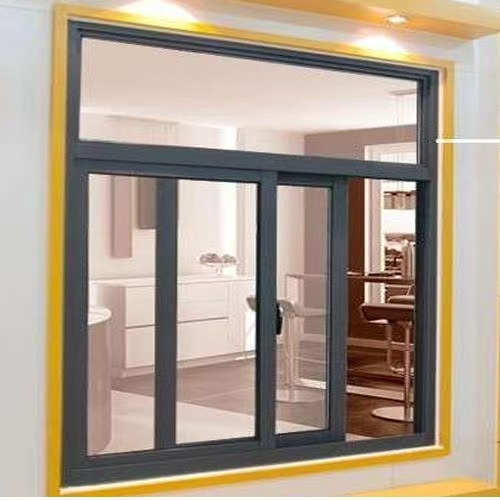
Sliding window profile system. The HM-U001/HM-U002 record is documented as 6063-T5, compliant with GB/T 13326, GB/T 7106, JG/T 215 and GB/T 8484, and suitable for coastal, plateau and rainy regions.
Have Questions or Need More Details?
Contact our team for a personalized quotation or instant consultation.
Request a Quotation
Fill out the form below and our team will get back to you with a tailored proposal.
WhatsApp Direct Chat
Prefer to chat in real-time? Message us on WhatsApp for instant assistance & quick answers.
- Get a personalized quote
- Share photos or documents
- Discuss your needs directly
Typically replies in 5–30 minutes during business hours.