
Sliding Door & Window Profiles: Alloys, Tolerances, Specs
Sliding Door & Window Profiles: Alloys, Tolerances, Specs
Two sliding systems can carry the same alloy designation, the same nominal wall thickness and the same finish name, and still fail acceptance on arrival. The reason is rarely the aluminium. It is that the order never stated which tolerance class applied, which pressure value sat behind 'Level 4', or which standard the coating was measured against.
This guide builds the specification in seven clauses for engineers and specifiers working on sliding door and window systems: four 6xxx alloys and the temper decision, the tolerance regime that decides whether sashes and hardware fit, the 4–6 m supply length, glass compatibility from 5–12 mm on windows and 4–12 mm on doors, sash and panel limits, the five performance benchmarks, and finish selection for coastal, plateau and rainy sites. Each clause is written so it can be pasted into a technical annex and measured against a delivery.
Why profile specifications fail at acceptance, not at quotation
The profile is one input among several. Glass, gaskets, hardware, fabrication and installation all sit between the extrusion and the finished window, and the grades buyers argue about — air, water, wind, thermal, acoustic — are measured on the assembly, not on the bar.
Four gaps account for most disputes: a performance grade written without its pressure value; an alloy named without its temper; a standard cited without a tolerance class or a named dimension to measure; and a finish described with an adjective — 'anodized', 'wood grain' — instead of a standard part, a class and a test method. Each gap produces the same outcome: quotes that look comparable on price and are not comparable on scope, and an acceptance conversation that happens after the material is on site.
The workable fix is to split the guarantee into two layers. The profile layer — alloy, temper, wall, cross-section and form tolerances, finish — is what an extruder can warrant and what a mill certificate and finish report can prove. The assembly layer — the five performance numbers — belongs to whoever fabricates and tests the window. A supplier that does both can carry both; a supplier that only extrudes cannot, and should not be asked to sign for a window it never built.
How the standard system divides the work
The standards governing a sliding system do not sit in one document, and that split is where specifications go wrong.
Product standards for the extrusion. In China, GB/T 5237 divides architectural aluminium profiles into six parts by finish: base material, anodized, electrophoretic coated, powder coated, fluorocarbon coated, and thermal-break profiles. General industrial profiles sit under GB/T 6892, and dimensional deviation has its own standard, GB/T 14846. In Europe, EN 755 covers inspection and delivery (-1), mechanical properties (-2) and profile tolerances (-9), with EN 12020-1 and EN 12020-2 dedicated to 6060 and 6063 precision profiles; chemical composition is defined in GB/T 3190 and EN 573-3. In North America, ASTM B221 is the general extrusion specification and the AA temper system supplies state designations.
Test methods for the assembly. Air permeability, water tightness and wind pressure resistance are established by testing the window or door, and thermal transmittance is measured on the assembly too. GB/T 7106 and GB/T 8484 are the method standards cited for those results. Behind finish claims, ISO 9227 defines the salt spray test and ISO 2409 the cross-cut adhesion test.
The project's own citation set. A Chinese-market annex typically cites GB/T 7106 and GB/T 8484 for performance alongside JG/T 215 and GB/T 13326 for the component requirements the project relies on. Editions matter: the edition year fixes the test procedure and the grade table, so the annex should name it rather than quoting a number alone.
Capacity is not what separates suppliers in this category. China's total aluminium extrusion consumption was estimated at 22.87 million tonnes for 2025 (AL Circle, September 2026), so material is available from many mills. What separates them is whether a stated dimension, temper and finish class hold across a production run — which is precisely what a clause-level specification tests.
Clause 1 — Alloy and temper: four grades, one decision rule
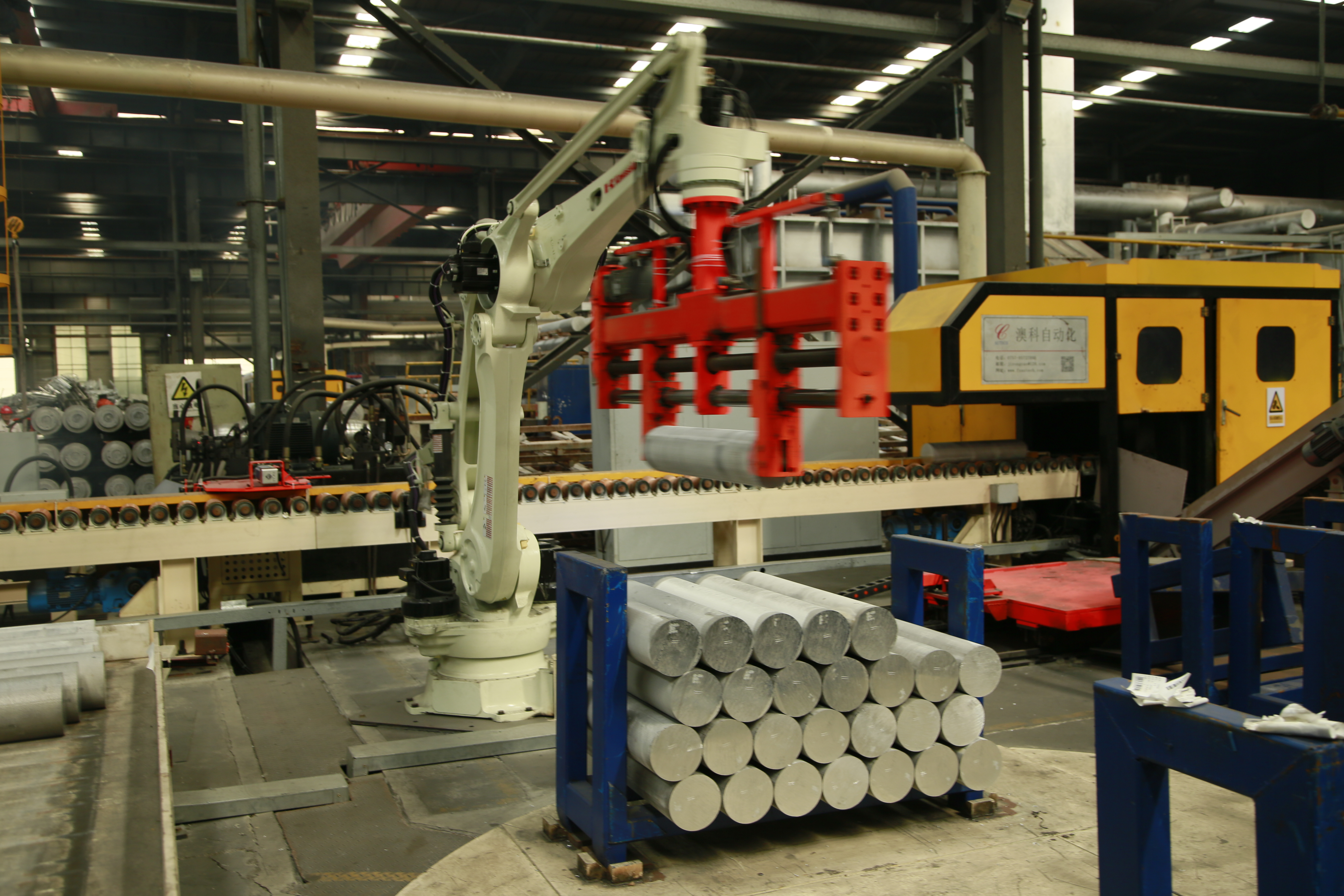
All four grades in this guide — 6063, 6061, 6005A and 6082 — belong to the Al-Mg-Si 6xxx family of heat-treatable alloys, with compositions defined in GB/T 3190 and EN 573-3. They are not interchangeable, and the differences that matter are strength, extrudability and surface quality.
6063-T5 is the baseline architectural grade. Its lower magnesium and silicon content gives it the best extrudability and surface quality of the four, which is why it dominates door, window and curtain-wall profiles. GB/T 5237.1 sets the minimum properties for 6063-T5 base material at Rm ≥ 160 N/mm², Rp0.2 ≥ 110 N/mm² and elongation A ≥ 8%. Those are minimum specified values for acceptance, not typical mill results, and they belong in the annex as a floor rather than a target.
6061-T6 carries more magnesium and usually added copper, which raises strength; it serves structural load-bearing members, industrial profiles and automotive parts, and appears in curtain-wall structural members. 6005A is also a higher-strength 6xxx grade and substitutes for 6063 in some structural applications. 6082-T6 is specified alongside 6063-T5/T6 and 6061-T6 where curtain-wall members need higher strength.
The decision rule is to specify the lowest grade that clears the structural calculation. Because 6063 is the easier-extruding, better-surface grade, stepping up to 6061 or 6082 without a strength reason buys capacity the design does not use and gives up surface quality and process margin in exchange. The temper belongs in the same clause: 6063 is used in both T5 and T6 for curtain wall, and 'aluminium 6063' without a temper is an incomplete requirement that a mill can satisfy several ways.
Two checks close this clause. The mill certificate must state alloy and temper and must be issued for the heat the profiles came from. The annex should also say what happens when certificate and delivered temper disagree — re-test, or reject.
Clause 2 — Tolerances: name the standard, the class and the dimension

Dimensional deviation is governed separately from the product standard. GB/T 14846 covers dimensional deviation for extruded profiles in China, EN 755-9 covers profile dimensions and form in Europe, and EN 12020-2 sets the tolerance regime for 6060 and 6063 precision profiles. Each works by tolerance class, and quoting one without a class leaves the acceptance criterion open.
For a sliding system, three groups decide whether the window assembles and runs:
- Wall thickness. State nominal and minimum-at-any-point as two separate figures. A nominal wall alone lets a thin section pass, and wall drives both the structural result and hardware screw engagement.
- Cross-section dimensions. Glass groove, hardware channel and track width are the dimensions that either accept the bead and roller or do not.
- Form tolerances. Twist, straightness and angularity surface later, as a diagonal gap in a closed sash or a track that stiffens over its length.
The practical rule is to write the standard, the edition, the class, and the two or three dimensions you will actually gauge on receipt. 'Meets GB/T 14846' is not measurable; a classed requirement naming the track width and the minimum wall is. Where precision matters — long sashes, tight hardware, visible joints — ask which regime the supplier quotes to and whether it can supply to EN 12020-2. A factory that can answer that question has a tolerance system rather than a tolerance claim.
Measure on the longest piece in the delivery, not a short sample. Twist scales with length, and a 300 mm offcut will pass a check that the 6 m bar fails.
Clause 3 — Supply length: 4 m, 6 m, and what the choice changes
Architectural profiles are supplied in standard extruded lengths of 4–6 m. The choice is not cosmetic. Longer stock reduces joints and cut loss on long sash and track pieces, but it changes handling, packing and freight. Shorter stock is easier to move and pack and produces more offcut against a long cut list.
Four items belong in the annex: the ordered length, the length tolerance, the cut list, and whether cut-to-length falls inside the supplier's scope. Even when cutting happens downstream, the cut list should travel with the order, because it determines how much of each bar becomes product and how much becomes scrap — and scrap is priced into the bar.
If an order mixes lengths, settle the packing scheme before the purchase order rather than after it. Length, bundle size and packing method are one decision, and deferring it to the shipping stage is how a 20-day lead time becomes a month.
Clause 4 — Glass thickness: 5–12 mm on windows, 4–12 mm on doors
Sliding window systems are specified for 5–12 mm glass and sliding door systems for 4–12 mm. The wider door range is the one to note: a door profile can be ordered for a 4 mm make-up that a window profile cannot.
A compatibility range is not a self-adjusting feature. The aluminium groove is fixed; what absorbs the difference between 5 mm and 12 mm is the glazing bead and gasket combination. That is why the order must carry the glass make-up and the bead and gasket part numbers, not just the profile's stated range. A stated range tells you which beads exist; it does not tell you which bead is in the box.
The failure mode is a late glass substitution. If the make-up changes from 6 mm to 8 mm after the profiles are extruded, the beads change with it, and on a project with a fixed installation date that is a second order rather than an adjustment. Fix the glass make-up first, then confirm bead and gasket part numbers against it in writing.
Clause 5 — Sash and panel limits are calculated, not catalogued
Sash and panel dimensions are derived from four inputs: the wind pressure requirement for the location and height, the weight of the glass make-up, the load rating of the hardware, and the allowable deflection of the profile. A catalogue maximum speaks to one of those inputs; a check speaks to all four.
Panels and sashes are not interchangeable at the same outer dimension. A fixed panel carries glass and wind load; an operable sash also carries rollers, a lock and the movement of every opening cycle. The same width that works as a fixed lite can be too large as a sash.
In the evaluation stage, give the supplier the two numbers that matter — your largest intended sash and your heaviest glass make-up — and ask for the check against those rather than against a catalogue range. In the annex, record the maximum sash width and height together with the glass weight that produced the limit and the deflection criterion applied. Without the glass weight, a maximum dimension is not reproducible by a second supplier, and the two quotes cannot be compared.
Clause 6 — The five benchmarks, and who warrants each one
The performance set for a sliding system is normally written as five targets. Each is an assembly result, and each is easy to write in a way that cannot be tested.
| Parameter | Benchmark | Measured on | What the annex must add |
|---|---|---|---|
| Air permeability | ≥ Level 6 | Assembled window or door | GB/T 7106 edition, level and test pressure |
| Water tightness | ≥ Level 4 (≥ 500 Pa) | Assembled window or door | The pressure value itself, not only the level number |
| Wind pressure resistance | ≥ Level 6 | Assembled window or door | Level, test pressure and design wind load |
| Thermal transmittance | K ≤ 2.5 W/m²·K | Assembled window or door | K value with GB/T 8484 edition and the glazing and spacer make-up |
| Sound insulation | ≥ 30 dB | Assembled window or door | The rating descriptor used in the test report |
Two entries need more than a number. Water tightness is graded in levels defined by pressure, so writing 'Level 4' alone ties the requirement to an edition rather than to a performance. Writing '≥ 500 Pa' keeps it fixed if the grading table changes, and the same logic applies to air permeability and wind pressure: level and pressure should both appear.
Thermal transmittance at K ≤ 2.5 W/m²·K is not reached by a single-material aluminium extrusion; it is normally achieved with a thermal-break profile. GB/T 5237.6 covers thermal-break architectural profiles in two routes — strip, using PA66 polyamide, and pour, using polyurethane — and the two differ in equipment, capacity and cost structure. That makes the route a supplier-selection question rather than a detail: a factory set up for one route cannot quote the other, and asking which route a supplier runs tells you more than asking whether it makes thermal-break profiles at all.
The division of responsibility is the part most specifications leave out. The extruder warrants alloy, temper, wall, tolerances, finish and the thermal-break construction. The fabricator warrants the five grades, because it tests the assembly. Put that split in the annex, name the party for each of the five numbers, and require the test report with the delivery.
Clause 7 — Finishes: match the class to the exposure, not the colour
| Finish | Standard anchor | What it is | What the annex must state |
|---|---|---|---|
| Mill finish | None — uncoated | Extruded surface with no applied coating | 'Mill finish'; coating clauses do not apply. Use where the surface is further processed or not exposed |
| Anodizing | GB/T 5237.2; AAMA 611 | Electrochemically formed oxide layer | Film thickness class — AAMA 611 Class I ≥ 18 μm, Class II ≥ 10 μm |
| Electrophoretic coating | GB/T 5237.3 | Organic coating applied electrophoretically | GB/T 5237.3 as the basis, not 'anodized' or 'coated' |
| Powder coating | GB/T 5237.4; QUALICOAT | Powder applied and cured | Standard, class, adhesion to ISO 2409, salt spray to ISO 9227 with the product standard's pass criteria |
| Fluorocarbon (PVDF) | GB/T 5237.5; AAMA 2605 | High-performance organic coating | One named acceptance basis per project |
| Wood grain transfer | Base coating standard | Decorative transfer film over a base coating, usually powder | The base coating standard plus the transfer as an agreed additional requirement |
The fluorocarbon trap. AAMA 2605, the QUALICOAT class system and GB/T 5237.5 all address high-performance coatings, and they do not use the same accelerated ageing cycles or pass thresholds. A coating cannot be graded as equivalent across them, and a specification asking for 'AAMA 2605 and QUALICOAT Class 2' without naming the acceptance basis creates a dispute at the first inspection. Name one basis per project, per market.
Wood grain. GB/T 5237 is organised by coating type and has no separate wood-grain part. The base coating therefore carries the standard requirement, and the transfer layer should be written as an additional decorative requirement with its own agreed test. Anything else leaves the decorative surface without an acceptance anchor.
Salt spray is not a grade. ISO 9227 defines how the test is run; whether a sample passes depends on the pass criteria in the product standard being applied. A claim of 1000 hours salt spray with no product standard and no pass criteria is not comparable with another supplier's 1000 hours and should not be treated as though it were.
Exposure mapping. Coastal sites turn the decision into a corrosion question, so finish should be specified by class — anodizing to AAMA 611 Class I at 18 μm minimum where a metallic finish is wanted, or a coating specified against the higher performance class the project adopts. Plateau sites combine a higher UV dose with temperature cycling and wind load, which is what a coating's ageing test targets; specify the performance class and the wind pressure grade together rather than treating finish as a colour choice. Rainy sites make water tightness the controlling number and put the finish under standing water at the track, so the pressure value and the drainage path belong in the same clause as the coating.
Building the annex in one pass
- Fix the duty from the site. Design wind load, exposure category, thermal target and acoustic target — before any product is named.
- Set alloy and temper from the structural calculation, with the minimum mechanical values you will accept written beside them (6063-T5: Rm ≥ 160 N/mm², Rp0.2 ≥ 110 N/mm², A ≥ 8% to GB/T 5237.1).
- Set the tolerance regime: standard, edition, class, and the dimensions you will gauge.
- Set lengths, the cut list and the packing scheme as one decision.
- Fix the glass make-up, then the bead and gasket part numbers against it.
- Fix sash and panel limits using the supplier's check on your largest unit and heaviest glass.
- Fix the finish by standard, class, test method and pass criteria — one acceptance basis per project.
- Fix the evidence list: mill certificates for alloy and temper, finish test reports, pre-shipment inspection, and a certificate whose scope actually covers the finishing route you ordered.
- Fix the commercial numbers: MOQ, Incoterm, payment split and lead time as figures, with re-test responsibility stated.
Nine items, one page. The test of a finished annex is simple: could a second supplier quote against it without a call, and could an inspector reject a delivery against it without an argument? If either answer is no, the clause is still an adjective.
Two scenarios: one conditional, one documented
Consider a conditional case. A 30th-floor sliding window on a coastal site, 6 mm glass, a thermal target of K ≤ 2.5 W/m²·K and a water tightness requirement of at least 500 Pa. The clause set that follows is narrow: a thermal-break profile in either strip or pour construction, 6063-T5 unless the wind load calculation pushes to a higher grade, anodizing to AAMA 611 Class I where a metallic finish is specified or a coating against the adopted performance class, a stated tolerance class for the track, and the five grades carried by the fabricator with test reports. Every item is checkable at delivery. The scenario is illustrative and is not a record of a built project.
The documented case is a Brazilian window and door OEM that has run 2,000 tons of Haomen Aluminum architectural profiles over ten years, with stable operation recorded and the material described as solid and durable. What that record supports is repeatability across a long production relationship — the property a tolerance clause exists to protect. It does not publish rejection rates or measured performance values, and it should not be read as though it did.
Where Haomen Aluminum fits in this specification
Haomen Aluminum (Shandong Haomen Aluminium Industry Co., Ltd.) is a manufacturer that integrates research, design, production and sales of aluminium alloy architectural and industrial profiles. It was founded in 2004 and operates from Luozhuang District, Linyi City, Shandong, on a 270,000 m² site with a published annual output of 100,000 tons and around 1,500 employees.
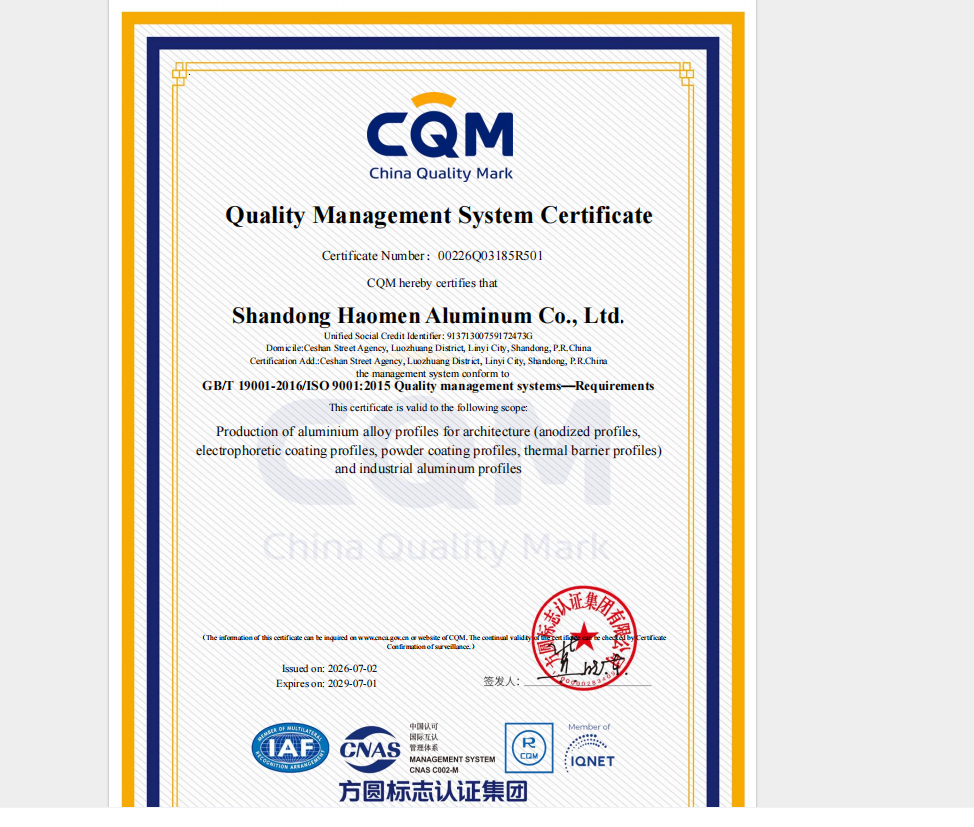
The document that matters most for this guide is the certificate scope. Haomen holds ISO 9001 certificate 00226Q03185R501, issued by China Quality Mark Certification Group on 2 July 2026 and valid to 1 July 2029. Its scope covers production of aluminium alloy profiles for architecture — anodized, electrophoretic coated, powder coated and thermal-barrier profiles — plus industrial aluminium profiles. In clause terms, four of the finish routes in Clause 7 and the thermal-break construction in Clause 6 sit inside the certified scope. Fluorocarbon is not listed there, so a PVDF order needs its own evidence rather than an assumption carried over from the anodizing line.
The company also holds IATF 16949:2016, ISO 14001 and ISO 45001. Production is OEM with logo customization, monthly capacity is 8,000 tons, MOQ is 5 tons and lead time is 20 days, with 100% testing and remote after-sales support. Export markets are South America and Africa, with company-reported shipments also to the United States, Canada, Australia, Brazil, Argentina, Russia, Germany and Spain.
What this section does not claim is a comparative advantage. No independent source in this guide benchmarks Haomen's dimensional capability or finish durability against named competitors, and a certificate scope describes what is certified, not how a specific order will run. The verifiable facts are the scope, the certificate number and dates, the capacity and the terms — which is exactly what a supplier-evaluation clause should be built on.
Frequently asked questions
Which alloy and temper should a sliding door and window profile specification name?
Name both. 6063-T5 is the baseline for architectural sliding doors and windows: GB/T 5237.1 sets minimum properties of Rm ≥ 160 N/mm², Rp0.2 ≥ 110 N/mm² and elongation A ≥ 8% for 6063-T5 base material, and those are acceptance minimums rather than typical mill results. Where the structural calculation needs more strength, 6061-T6, 6005A or 6082-T6 are the higher-strength 6xxx options used in structural and curtain-wall members. Because 6063 extrudes more easily and gives better surface quality, specifying a higher grade without a strength reason trades surface and process margin for capacity the design does not use.
Are air, water and wind grades properties of the profile or of the finished window?
They are properties of the finished assembly. Air permeability, water tightness and wind pressure resistance are established by testing the window or door, and thermal transmittance is likewise an assembly value; GB/T 7106 and GB/T 8484 are the method standards cited for those results. The profile contributes alloy, temper, wall, thermal break and finish, which is what an extruder can warrant. The grade itself must be warranted by whoever assembles and tests the unit, so the contract should state which party carries each of the five numbers.
Which tolerances must the purchase order state?
Three things: the standard, the tolerance class, and the dimensions you will actually measure. Dimensional deviation is governed separately from the product standard — GB/T 14846 in China, EN 755-9 for extruded profiles, EN 12020-2 for 6060 and 6063 precision profiles. For sliding systems the dimensions that decide fit are wall thickness, the glass groove and hardware channel, and form tolerances such as twist and straightness. A general statement of conformity to a standard is not a measurable acceptance criterion, because it does not say which class applies to which dimension.
OEM door and window aluminum profile manufacturer: what should the audit cover?
Start with the certificate scope, not the certificate. An ISO 9001 certificate is only useful if its scope names the finishing routes you are ordering; Haomen Aluminum's certificate 00226Q03185R501, issued by China Quality Mark Certification Group and valid from 2 July 2026 to 1 July 2029, covers anodized, electrophoretic coated, powder coated and thermal-barrier architectural profiles plus industrial profiles. Then confirm alloy and temper control through mill certificates, the tolerance regime the factory quotes to, the finish test methods and pass criteria, and whether OEM work includes logo and packaging customization. Routes outside the scope, fluorocarbon for example, need separate evidence.
What are the MOQ, lead time and acceptance terms on an OEM profile order?
For Haomen Aluminum the published terms are a 5-ton MOQ, FOB delivery, a 20-day lead time, 100% testing with pre-shipment inspection as the acceptance criterion, and 30/70 payment. Monthly capacity is 8,000 tons and production mode is OEM with logo customization. These are Haomen's terms rather than a market benchmark; ask every supplier on the shortlist for the same five numbers so the comparison is like for like, and agree in advance which party pays for re-testing if a pre-shipment result fails. Sample requests and the full catalogue are available through the contact details below.
Conclusion
A sliding system specification is decided by the clauses that can be measured: alloy and temper with minimum mechanical values, a tolerance class with named dimensions, a length and cut list, a glass make-up with matching beads, sash limits carrying the glass weight that produced them, five performance grades with pressures and editions, and one finish standard with pass criteria. The rest — the adjectives — can be removed without losing anything.
The two layers should stay separate in the contract as well. The extruder signs for the profile; the fabricator signs for the assembly grades. Projects that blur that line spend their inspection budget resolving a question that was never answerable in the first place.
Next step
Haomen Aluminum supplies architectural and industrial aluminium profiles for OEM window and door programmes, with a 5-ton MOQ and a 20-day lead time. To move from clause list to quotation, send the alloy and temper, the tolerance class, the cut list, the glass make-up, the five performance targets and the finish basis in one document — that is enough to quote against without a follow-up call.
Download the catalogue: E-Catalog of Shandong Haomen Aluminio (PDF) · Website: www.haomenly.com
Contact: Melisa Ying · Email haomen2004@gmail.com · Tel / WhatsApp +86 15153910991 · Ceshan Industrial Park, Linyi City, Shandong Province, China.
Have Questions or Need More Details?
Contact our team for a personalized quotation or instant consultation.
Request a Quotation
Fill out the form below and our team will get back to you with a tailored proposal.
WhatsApp Direct Chat
Prefer to chat in real-time? Message us on WhatsApp for instant assistance & quick answers.
- Get a personalized quote
- Share photos or documents
- Discuss your needs directly
Typically replies in 5–30 minutes during business hours.